
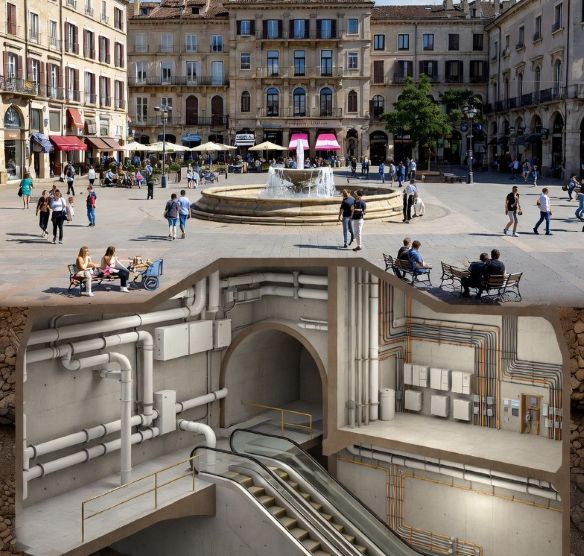
Urban tourism generates billions in revenue each year, with the World Travel and Tourism Council reporting that cities account for more than 70% of global tourism spending. In places where narrow streets, historic districts, and dense infrastructure meet heavy visitor traffic, even a small disruption can ripple through the local economy. This reality became clear in the coastal city of Valencia, where peak travel season collided with a growing problem beneath the streets.
Early Signs Beneath the Surface
The first signs were subtle, a faint odor near the old quarter, occasional drainage issues in boutique hotels, and slow-moving traffic caused by minor road closures. Local officials soon confirmed the issue: aging sewer lines were failing. Traditional repair methods would require digging up roads for weeks. For a city reliant on tourism, that was not an option. Engineers proposed a faster, less invasive solution, drawing insights from projects documented by the European Federation of National Associations of Water Services. They recommended trenchless methods similar to those used in modern sewer repair (riool reparatie) services, where underground pipes are restored without major excavation.
A Difficult Decision for City Leaders
Despite the urgency, city leaders hesitated at first. Businesses feared disruption more than the problem itself. Café owners worried about losing foot traffic, while hotel managers braced for cancellations. Yet delaying repairs would risk worse damage. Data from the American Society of Civil Engineers indicates that failing sewer systems can lead to sudden collapses, which are far more costly and disruptive than planned maintenance. The choice became clear, act quickly and quietly, or face a crisis in full view of tourists.
Repairing Without Stopping the City
Work began at night. Instead of tearing up entire streets, crews accessed pipelines through small entry points. Resin-lined materials were inserted and cured within existing pipes, strengthening them from the inside. This approach, often called trenchless sewer repair, allowed most roads to remain open during the day. Visitors strolling through Valencia’s historic plazas noticed little more than a few discreet work zones.
These efforts reflected a broader shift in urban infrastructure management. Research from the International Water Association highlights that trenchless technology can reduce project timelines by up to 50%. For cities dependent on steady visitor flow, this efficiency matters. It protects not only the physical environment but also the livelihoods tied to tourism.
Business as Usual Above Ground
As days passed, the feared disruptions never fully materialized. Restaurants stayed busy, guided tours continued, and street performers entertained crowds as usual. Beneath their feet, however, a quiet transformation was underway. Damaged pipelines were being reinforced using advanced pipe rehabilitation techniques, ensuring long-term stability without sacrificing the city’s rhythm.
Business owners began to notice the difference. Elena Torres, who runs a small guesthouse near the cathedral, remarked that bookings remained steady throughout the repair period. She had expected cancellations but instead received positive feedback from guests who appreciated the city’s clean and well-maintained environment. Her experience echoed findings from the Organisation for Economic Co-operation and Development, which notes that infrastructure reliability plays a key role in visitor satisfaction. At the same time, evolving bleisure travel trends shaping modern tourism show that travelers are staying longer and blending work with leisure, making uninterrupted city experiences even more important.
Business owners began to notice the difference. Elena Torres, who runs a small guesthouse near the cathedral, remarked that bookings remained steady throughout the repair period. She had expected cancellations but instead received positive feedback from guests who appreciated the city’s clean and well-maintained environment. Her experience echoed findings from the Organisation for Economic Co-operation and Development, which notes that infrastructure reliability plays a key role in visitor satisfaction.
A Model for Modern Cities
By the end of the season, Valencia had not only resolved its sewer issues but had done so without major economic loss. The success of the project sparked conversations in other cities facing similar challenges. Urban planners began to see trenchless pipe restoration as more than a technical solution. It became a strategic tool for protecting tourism and preserving daily life.
These challenges underscore a larger lesson. Cities are living systems, where visible charm often depends on hidden networks. When those systems fail, the impact reaches far beyond infrastructure. It touches businesses, workers, and visitors alike. By choosing modern sewer maintenance approaches over traditional excavation, cities can address problems early while maintaining their appeal.
Looking Ahead: Quiet Solutions, Lasting Impact
Looking ahead, the role of innovative pipeline repair methods will only grow. Climate change, population growth, and aging infrastructure continue to strain urban systems worldwide. Experts from UN-Habitat emphasize the need for resilient and adaptable solutions that minimize disruption. Trenchless sewer rehabilitation fits this vision, offering a balance between progress and preservation.
Valencia’s story shows that even in moments of uncertainty, thoughtful planning can keep a city moving. What could have been a season of disruption became a case study in quiet efficiency. By investing in modern underground repair techniques, cities can ensure that their streets remain vibrant, their businesses thrive, and their visitors leave with memories untouched by the challenges below.
In the end, the success of such projects lies in their invisibility. When done right, no one notices the work beneath their feet. Yet that unseen effort keeps everything above running smoothly, proving that smart sewer restoration is as essential to tourism as the attractions themselves.